Travel, Music & Life
Alle meine Hobbys
Ja, ich gebe ja zu, es kommt reichlich spät, aber ich habe noch eine Rekonstruktion vom Sauerbraten, in dessen Genuss ich letzten Montag noch einmal kam. Falls ich es nicht schon mal explizit erwähnt hatte - der Sauerbraten wurde von mir überwacht und zubereitet und das Rotkraut hat Loni gezaubert.

Dazu gab es einen 2003er Cabernet Sauvignon von den Sunrise-Weinbergen aus Chile. Den sollte ich mir merken, der war wirklich lecker...
Ich habe heute morgen festgestellt, dass ich noch den Text zu Motionfield's Music for Pictures schuldig bin. Der Beitrag wird entsprechend dem Erscheinungsdatum zurückdatiert und die Warm Moody Shores of Ambient können sich frei entfalten.
Transforming pictures into music is the motivation of the Swede Petter Friberg. At the age of 10, during the age of electronic innovators like Jean-Michel Jarre, Brian Eno and Kraftwerk, Petter did experiments using tape recorders. Together with Thomas Krome and friends he built up a studio during the mid 90's, listening to The Orb, F.S.O.L. and Aphex Twin. The efforts resulted in several techno/house 12''s under his 'Superstereo' moniker, but more recently Petter unveiled a new project with 'Motionfield', more focusing on warm, spheric ambient electronica with influences from Jazz and Field Recordings.
As the title of this release prompts, Petter thinks that songs convey static pictures. These recreate either a painted mood or the very moment of a photography. Living in the beautiful swedish countryside, surrounded by lots of untouched nature, Motionfield tries to express the moving pictures in his head with the help of moody electronic music. If you listen carefully you will figure that the tracks are internally split into pieces. These pieces seamlessly melt into each other and create a mental break in between, a transition to a new aural scenery, where both computers and analog synthesizers can be heard.
The musical journey starts with "The Colour of Water", a voyage within the depths of the dark blue ocean where distant sound of whales becomes audible. The scenery approaches the shores and finally leaves the water, taking a look at the play of light on the surface of the wide open ocean. Continuing with "Falling in Stillness" the listener enjoys staying at home watching outside the windows on a rainy day, listening to sounds that appear apart from the crackling rain on the window. With the rain fading out slowly, a warm cocoon of silence spreads that features a warm slowly swelling and returning sound.
The next image in the gallery is "Nothern Sky", yet again a warm and organic track with warm surrounding atmospheric sounds that convey a feeling of broken skies which are formed by long days in summer and by long nights in winter. When night falls feathery shivers of solar wind streak the magnetic field of the earth resulting in a glowing nocturnal sky. Closing this EP, with the last picture of Motionfields gallery he escorts a cargo of coffee from the misty dulled penchants carried by a train to the coffee machine that creates a smell of fresh warm coffee floating in waves across the room, stimulating the olfactory nervs.
With "Music for pictures" Petter Friberg conjures a gallery of pictures and moods that carry on the thought of the titles and create their own world, full of comfortable depths to dive into. Well done!
Heute hatte ich mir vorgenommen, die Berechnung und die Anzeige von einander zu trennen. Dazu habe ich in meiner Fraktalklasse aus einer Methode zwei gemacht. Eine zum Berechnen und eine zum Ausgeben. Die Oberfläche wurde davon kaum tangiert. Beim Ausgeben wird nur die Fraktalklasse nach dem Bild abgefragt. Dass das schon berechnet ist, interessiert dabei ja nicht. Ergebnis: Das Scrollen in der Grafik geht schön flüssig und ohne Ruckeln.
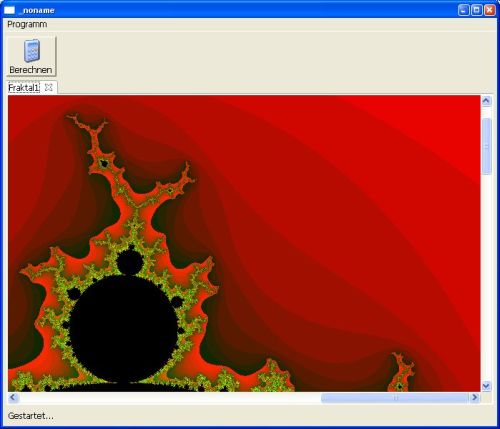
Dem Berechnen-Button wurde endlich ein Icon verpasst und Funktionalität hinterlegt. Wenn der Button gedrückt wird, wird das Fraktal neu berechnet. Und schon stehe ich wieder vor einem neuen Problem, dass kein Neues ist: Wenn ich auf den Button berechnen drücke, soll der Text der Statuszeile auf "Rechne..." gesetzt werden und sobald er fertig ist, wieder auf "Fertig...". Das Problem äußert sich dann wie folgt: Es bleibt "Gestartet..." stehen, er rechnet und wenn er fertig ist, blitzt kurz was auf und dann steht "Fertig..." da. Woran liegt das? Stichwort: Eventqueue. Wenn der Button gedrückt wird, geht das Programm in den dafür vorgesehenen Zweig der Eventbearbeitung. Solange der Event abgearbeitet wird, müssen andere Events warten. So auch die Events, die das Neuzeichnen der Statuszeile veranlassen.
Demzufolge ist die nächste Aufgabe: Der Buttonevent muss schnell verlassen werden und den Weg frei geben für die Ausgabe der Statusnachrichten. Realisierung: Mit Betreten des Eventhandler wird ein Thread gestartet, der Setzen des Textes, Berechnen und wiederum Setzen des Textes veranlasst.
Was zu einem wirklichen Problem werden kann, ist das Setzen einer benutzerdefinierten Palette. Momentan adressiere ich die Werte für die Pixel direkt, d.h. ich benutze jeweils einen Wert für jeden der RGB-Kanäle. Realisierungsmöglichkeiten:
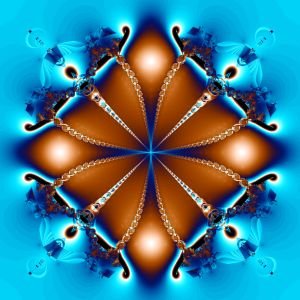
Mh, im Großformat sieht das viel besser aus!
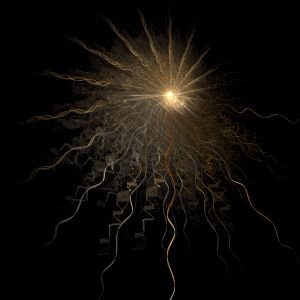
Heute kam die gestern angekündigte Version mit Scrollbalken dazu. An sich nicht sehr problematisch, aber ich habe noch Korrekturen an den Tabulatoren vorgenommen, sodass ich sämtliche Container erstmal entfernt habe, bis letztendlich nur Toolbar und Statuszeile übrig blieben und habe dann quasi von vorn begonnen. Somit sieht die Version von heute nicht wesentlich anders wie die von gestern aus.
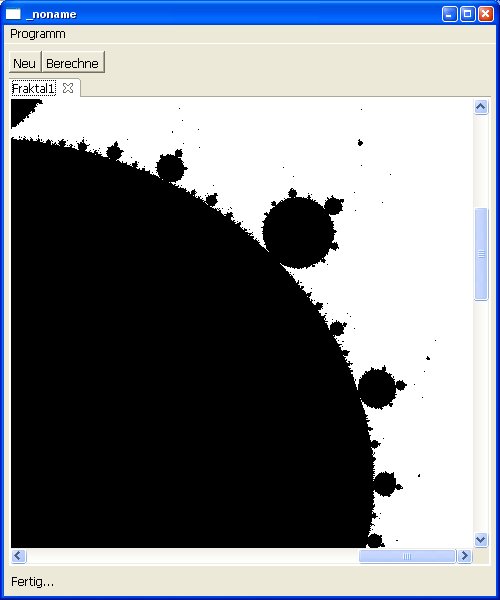
Gleichzeitig kam natürlich das Problem hoch, dass ich zur Zeit noch das Berechnen der Grafik an das Zeichnen des Bildes angeschlossen hab. Sprich: wenn man den Scrollbalken bewegt, wird jedes Mal das Bild neu berechnet. Also hab ich schon mal nachgesehen, wie ich das realisieren werde.
Meine Klasse Fractal hat momentan nur eine Methode drawImage. Diese zeichnet in den übergebenen Grafikkontext. Meine nächste Änderung wird also dahingehend erfolgen, dass diese Klasse die Bilddaten selbst speichert und über getImage die Bilddaten zurückgibt und mit calculateImage das Bild neu berechnet. Parameter werden die Bildgröße und die Farbpalette sein - somit hab ich gleich die Tür offen, um eventuell eine kleine Vorschau zu berechnen.
Im Hauptprogramm selbst wird der Listener nur noch die Grafik anfordern, beim ersten Mal natürlich erstmal berechnen. Ansonsten erfolgt das Berechnen nur noch, wenn der Button zum Berechnen betätigt wurde.
Diese Woche ist es wieder soweit gewesen - ein neuer Thinner-Release erschien. Diesmal Danny Kreutzfeld als Sectorchestra mit seinem Abschied No morchestra. Ich war selbst nicht so begeistert von meinem Text, deswegen wundert es mich auch nicht, dass er total umgeschrieben wurde.
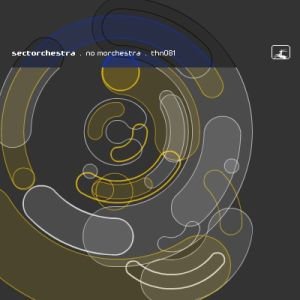
This release is special. Not only because it's Danny Kreutzfeldt's return to Thinner after his last EP from fall 2003 but also because it is the farewell of his Sectorchestra project. "No Morchestra" is a vast collection of tracks created in the past years that are now compiled into a constitutive album format. Sectorchestra is/was Danny Kreutzfeldt's project for abstract atmospheric house constructions. The contributions Danny did on Thinner under the Sectorchestra guise were known to be discrete releases, critics favourites, with both richness and diversity in terms of sound and aesthetics. Although this is the last Sectorchestra one, this vibrant danish bedroom scientist always has many other projects running so just check out his homepage to see his upcoming releases. Speaking about his overall output, Danny gains creative incitement from the darker sides of the human soul. To my ears, Sectorchestra has a special touch of fantastic advanced dungeons (AD & D) complexity clickhouse, that is original enough to make you feel unsure whether these grooves are intended for humid chamber floors or for atmospheric homelistening sessions in darkness that can turn out quite eerie. For sure Sectorchestra is a listening experience that demands attention from the listener, unlikely to many arbitrary dubby ambient releases this exemplar of release unveils it's craft by carefully listening to the detailism inside. Immediately you will figure that Sectorchestra is not about the chubby warmth many dub insprired recordings offer, in fact "No Morchestra" is the perfect complement to it by offering abstract, yet chilly mechanic clickhouse with inevitable groovey antipoles relating to the 4/4 grid. Gently slow and humid grooving downbeats open up the album. The first cut "People And The Things They Do" slowly marches distributing tantalisingly accentuated hats shooting first dub polar spells. This opener for this sinister journey is followed up by "Tabula Rasa" that carries on with different, more cautious beats but also more deep dripstone dubs. "Danish Throatsinging Dub" stays beyond ground level and grumbles with background throats that are diametral to this careful, almost marine tranquility whose signals originate from the calm twinkling background strings. "Taking It Back" then makes a cut with compact minimal winding beats that lead on to the 4/4 parts of the album. "Muted Day" creeps on the fragmented floor with bumping, fumbling crackles. Using a large spectrum of sound creation Sectorchestra moves from Jeannefair's vocals in "Downwards" to a more raw n dirty attituded motörhead clickhouse in "Extinguish my flame" to finally rotate into the twisted rhythmic drum patterns "Jamaica Hub" offers. "Redub (Version)" is a pool of rhythmic shifting microscope dubs while the outro "More Jingles" is instrumentalized with only a multiple modified jingle sample, a treated snare and a stretched pan pipe. And then it is over, a trippy hour journey into the evocative dungeons of Sectorchestra. One of the most consequent projects is closing it's gates to descend into the abyss, however the legacy remains.